
Dear reader,
I recently read Terry Godier's thought-provoking essay about RSS readers. It challenges the concept of an unread count that for most of us appears natural and necessary.
Email's unread count means something specific: these are messages from real people who wrote to you and are, in some cases, actively waiting for your response. The number isn't neutral information. It's a measure of social debt.
But when we applied that same visual language to RSS (the unread counts, the bold text for new items, the sense of a backlog accumulating) we imported the anxiety without the cause.
Admittedly, I have noticed how I often focus more on clearing my list of unread items instead of reading things people have written.
I discovered Artemis when a blogger I follow presented it as an RSS reader that could fix the issues Terry had identified in his article. So, I started testing.
Things I like
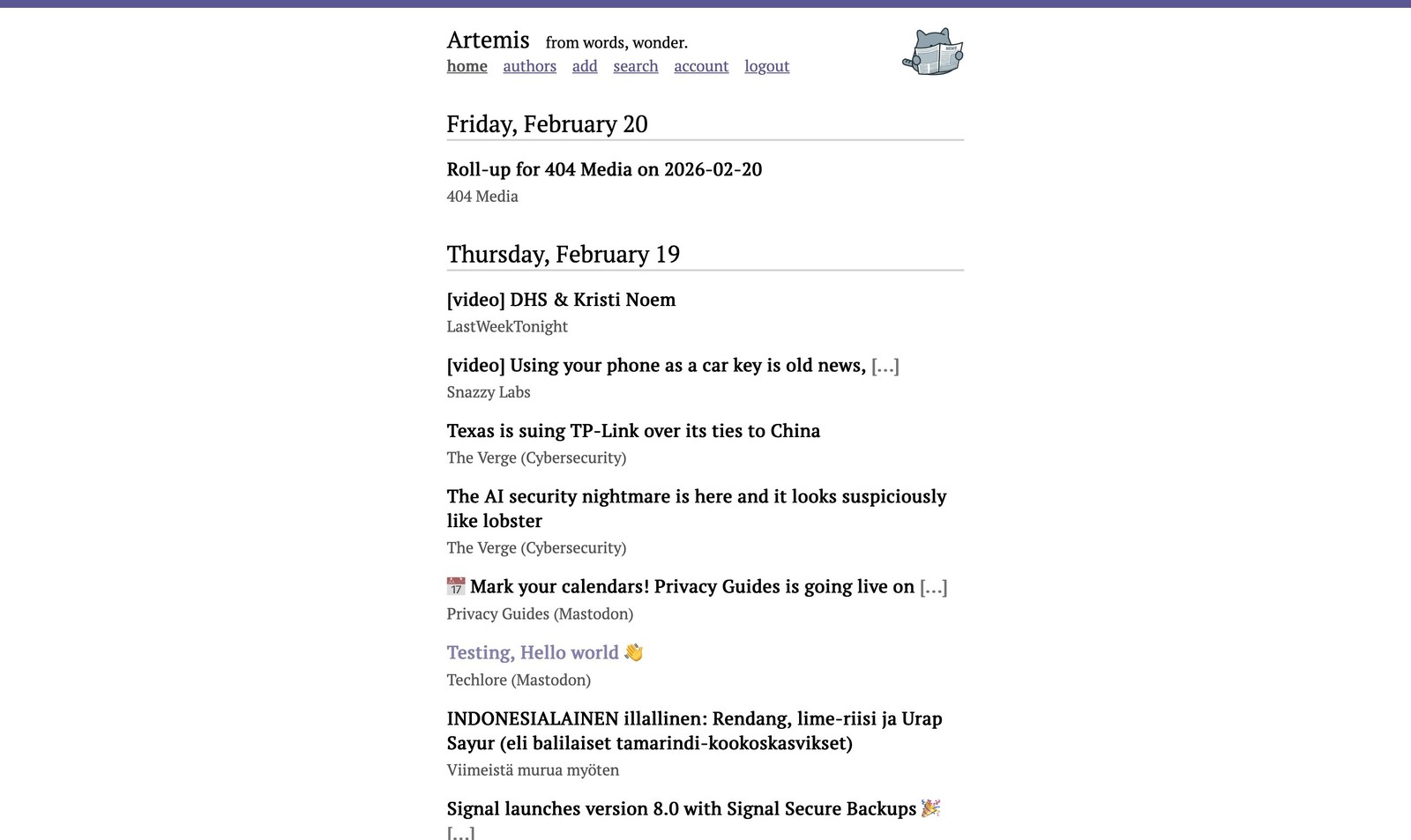
Artemis presents itself as a calm RSS reader, and from the beginning, I have enjoyed its clean, minimalist, but still functional design that gives me everything I need, but not much more.
Compared to many alternatives, Artemis is free to use, but James (the developer) welcomes donations. You also need an invite code to create your account. I found one online, but it seems you should get one quickly by just asking.
Privacy-wise, Artemis isn’t as good as self-hosting or running something like NetNewsWire locally, but the privacy policy seems solid. It’s also great to see that Artemis supports passkey login. It would be nice if these cloud-based RSS readers could implement end-to-end encryption in the future, so that even they cannot see their users’ feeds. Alcove is the only option I have found that does this, but it has its own limitations and follows the traditional RSS design.
Going back to Artemis, it has felt refreshing to give up the number of unread items that always made managing my RSS feeds feel like a task I need to complete, when the focus should be more about enjoying the new content people are putting out.
Artemis refreshes the feeds only once per day, and I have grown to appreciate that. Before, I had a habit of checking my feeds countless times each day to get on top of new updates. With Artemis, I can't do this anymore since new feed updates appear only after midnight. I could try using another RSS reader and check the feeds once per day, but the key reason Artemis has worked so well for me is that it removes the temptation entirely.
My other favorite feature, Roll-up, allows me to dedicate busy feeds to their own days, and on those specific days, they don’t crowd the entire feed but add a single entry I can click to see all the posts from the past week. This is one of those features that you need to test yourself to realize how brilliant it is. Because of it, my feed is less busy, and I can be more intentional about what I want to read.
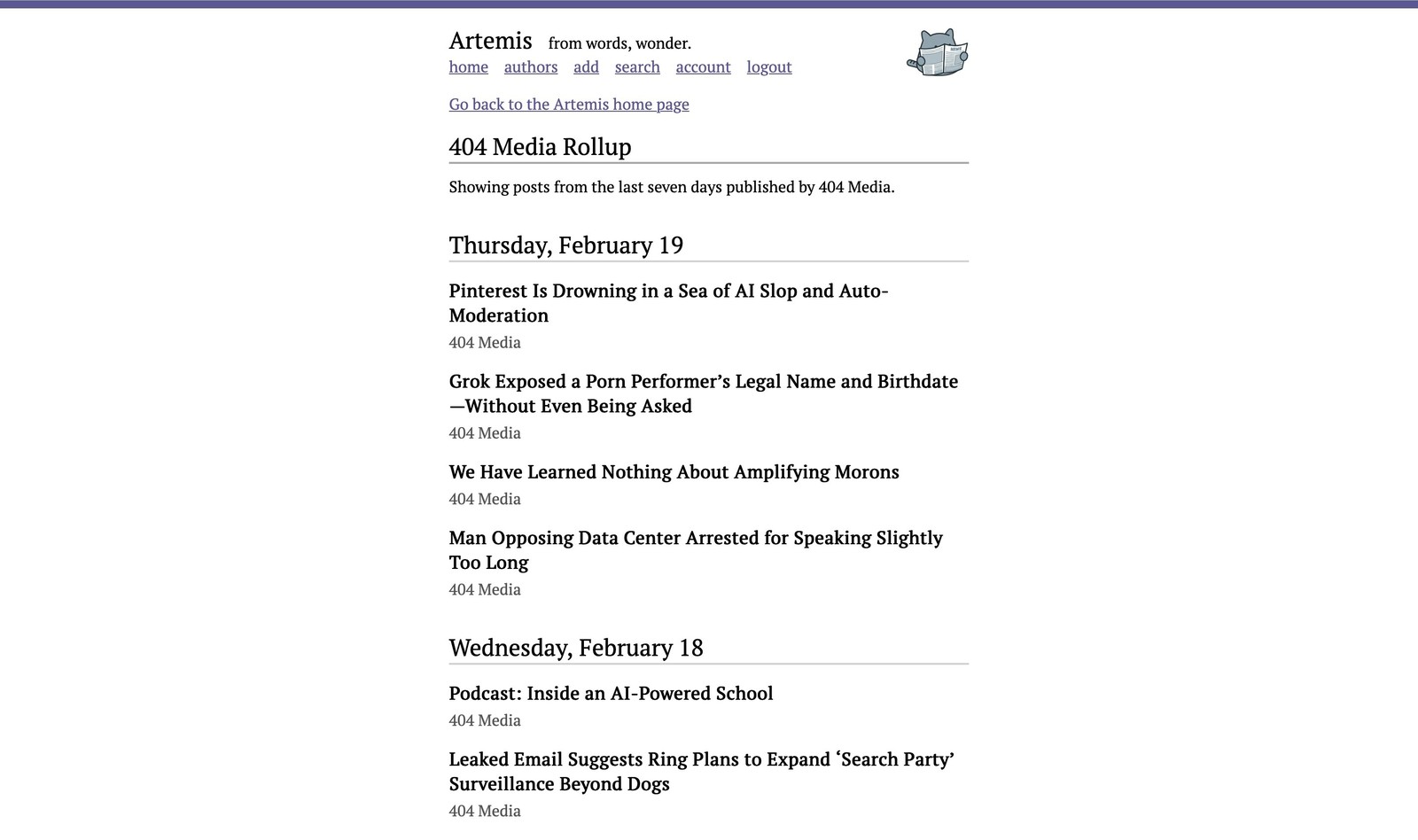
You may think that managing a high number of subscriptions requires an RSS reader that refreshes multiple times per day. This is what I always thought as well. But my experience with Artemis has shown me that checking them once per day is enough, especially when I can take advantage of the Roll-up feature.
Issues I encountered
After signing up, I discovered a few issues that I reported to James. While one got quickly fixed, the other one has proven more persistent. Since Artemis is free to use and developed by a single person, I’m not expecting a flawless experience.
There are no native apps, so you need to manage with the web app. For me, this isn’t an issue as I prefer my software to work across platforms.
Artemis is also not open source. James told me that managing this would include additional time and effort that he doesn’t have, but if he ever decided to shut down the project, he would probably open source it so people could keep it alive.
I also would love to have a built-in reader in Artemis, but James has decided otherwise since he likes to visit people’s websites, as many people put a lot of effort into them. He also wants to keep the scope of the project more manageable this way.
While visiting sites directly makes sense with people's personal websites and blogs, the situation is different with sites like Reddit, YouTube, and major news sites that I would just prefer to avoid for various reasons. While this isn't possible with Artemis, I'm willing to accept that compromise since I like its other features so much.
Discovering Current
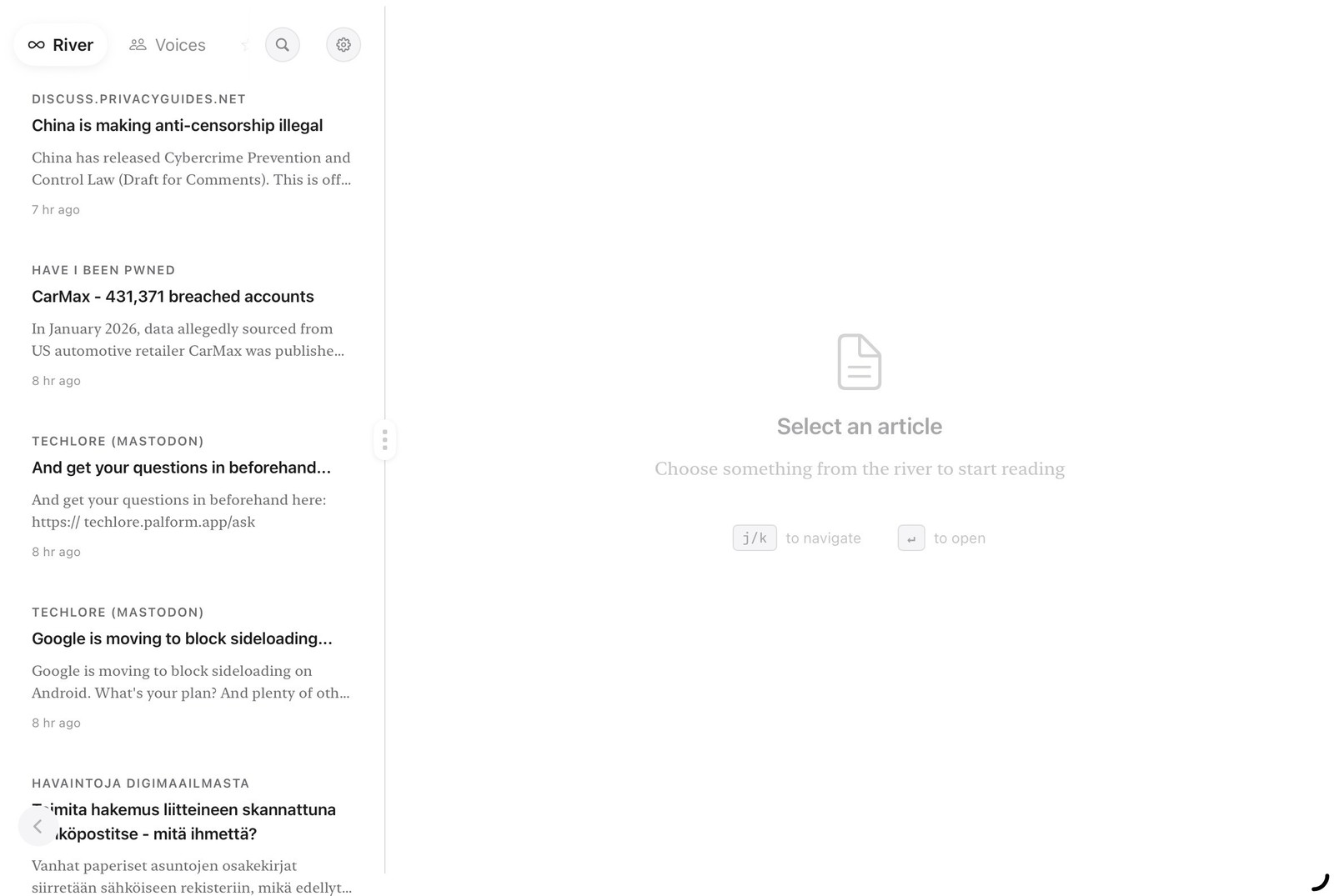
Recently, a new RSS reader called Current has been making waves in the RSS space. It’s developed by Terry Godier; the same guy who wrote the aforementioned article about RSS readers. Unlike Artemis, Current is a native app exclusive to Apple devices, but Terry has promised to change this soon. While it’s not free, it offers a lifetime purchase option for $9.99 that seems fair to me. While some have criticized the pricing and the lack of a free trial, Apple allows you to get a refund if you change your mind later.
Similar to Artemis, Current’s design is gorgeous, and I appreciate how much thought Terry has put into it, as is apparent from his introduction post. Current includes a beautiful built-in reader, which also improves your privacy as you can read the articles right there on the client.
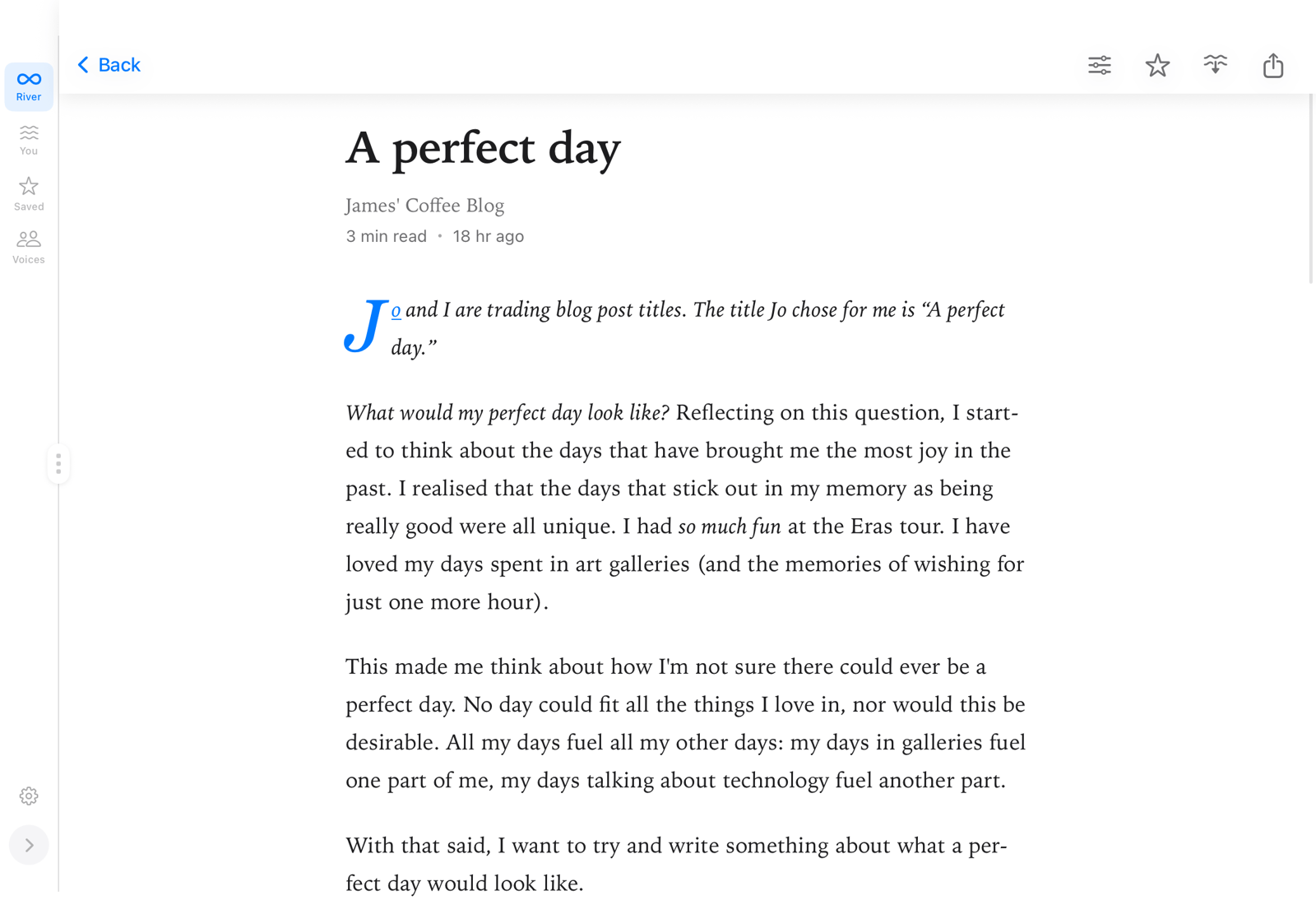
After Artemis solved my habit of checking my feeds constantly during the day, I was concerned if Current would make me return to this behaviour. Well, while I have been checking my feeds more often, it hasn’t felt performative. Instead, I come back when I want to. I think I can thank the lack of an unread count for this.
When you add new feeds, you also set their time period for how long they will stay on your homepage. The options range from 3 hours (breaking) to 7 days (evergreen). The design means that you will miss some updates each day for items with the shortest setting. You could avoid putting feeds into this category, but I think one of the main ideas with Current is that it’s okay to miss stuff sometimes, especially from feeds that publish a lot of content each day.
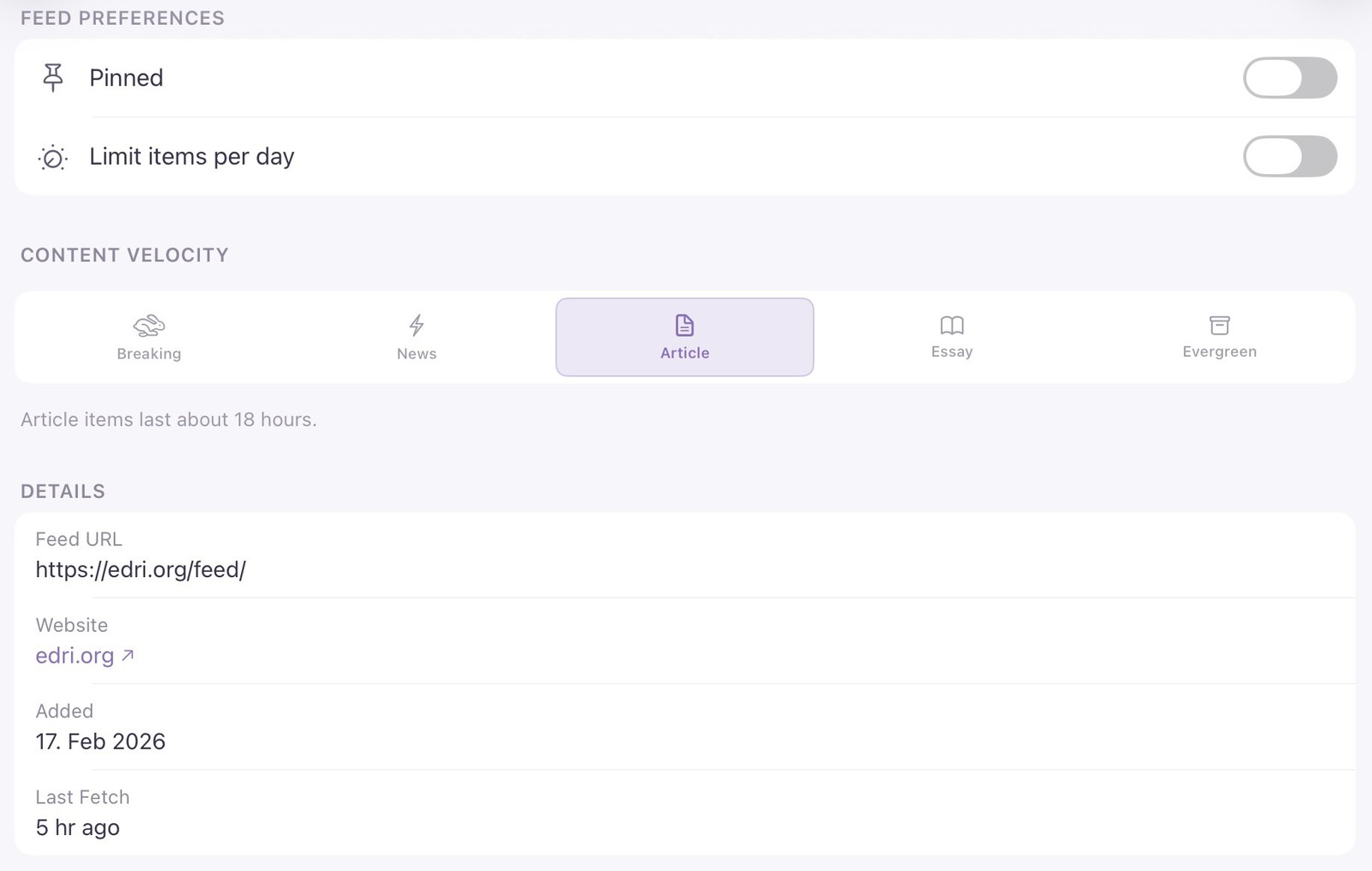
This is how Terry puts it:
The main screen is a river. Not a river that moves on its own. You're not watching content drift past like a screensaver. It's a river in the sense that matters: content arrives, lingers for a time, and then fades away.
The design makes more sense when you think about it enough. For example, you could subscribe to feeds that publish a lot of new content each day, and then open Current when you want to see what is happening in the moment. I won't do this because I want my RSS feed to be more about keeping up with individual people and quality journalism than getting quick updates from major news sites.
Some issues I have noticed include one feed that refuses to work and occasional syncing issues. The latter is something I became familiar with NetNewsWire when I was trying to sync things with iCloud. Current supports other syncing services, so using those may fix these issues.
Closing words
I intentionally left some things out of this article since I only wanted to write about my personal experience. So, I encourage you to test both Artemis and Current if anything I have written here has sparked your interest. While both present themselves as calm RSS readers, their designs differ quite a bit. I’m leaning towards Artemis, but will keep following Current to see how it develops in the future. Overall, it’s been so cool to see and explore these new offerings in the RSS space that are not afraid of doing things their own way. 🌔